Listen, watch, read: Celebrating disability with stories
Monday, 14 July 2025
-
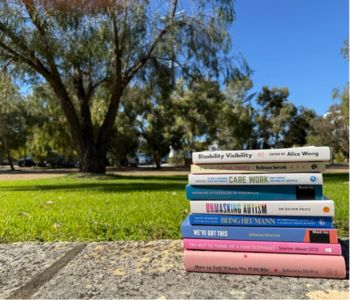
A few of the powerful titles featured – sharing lived experiences through books, podcasts, and film.
Stories are windows that help us see the world through someone else’s eyes. For people with disability, sharing their stories can be a powerful act of agency and advocacy, allowing people with lived experience to reclaim narratives society talks about disability and instead influence how we understand disability.
For disability allies, stories can be central to learning about the diverse and complex experiences of people with disability in their own words. These stories offer an avenue to challenge your own assumptions, reflect on your learning and grow your understanding of disability.
This guide curates a range stories by people with disability told as books, podcasts, and films. These stories are separated into three levels - Getting Started, Diving Deeper and Stories that Challenge, to help you start where you are, and find the types of stories you are ready to hear. Take a look through this collection and pick of few to start to explore disability from different angles and experiences. From light, accessible introductions to raw, transformative narratives, there's something here for every kind of learner.
Getting Started
The ‘Getting Started’ list is for those new to disability. These stories focus on disability inclusion basics through personal stories of people with disability, using clear accessible language.
Books
- Growing up Disabled in Australia - Edited by Carly Findlay
Growing Up Disabled in Australia is a powerful anthology that brings together over forty voices of people with disability and chronic illness, sharing deeply personal stories that challenge stereotypes and reveal the richness of lived experience. Through reflections on identity, exclusion, resilience, and pride, this collection invites readers to rethink where disability truly lies and to listen more closely to voices that are too often unheard - Sitting Pretty: The View from My Ordinary Resilient Disabled Body by Rebekah Taussig
Sitting Pretty is a candid and insightful memoir that explores life in a disabled body through personal stories, cultural critique, and sharp wit. Taussig challenges ableist assumptions and redefines disability as a rich, complex identity shaped by both personal experience and societal structures. Blending humour, vulnerability, and advocacy, the book invites readers to rethink independence, accessibility, and what it means to live a full life. - Disability Visibility – Edited by Alice Wong
Disability Visibility is an anthology of 37 essays written by disabled people, offering firsthand accounts of life, identity, activism, and resistance. The collection explores a wide range of experiences, from medical trauma and relationships, to art, politics, and the centring voices that are often marginalised or erased. Through these deeply personal and diverse narratives, the book challenges societal norms and celebrates the wisdom, resilience, and complexity of disabled lives.
Podcasts
- ListenABLE - Hosted by Dylan Alcott and Angus O’Loughlin
ListenABLE is a widely acclaimed Australian podcast that features candid conversations with disabled guests, aiming to challenge societal perceptions and break down stigma. With a mix of humour and heart, hosts Dylan Alcott and Angus O'Loughlin ask the questions people are often afraid to, creating space for honest dialogue. - Disability Visibility – Hosted by Alice Wong
Disability Visibility is a podcast hosted by San Francisco night owl Alice Wong featuring conversations on politics, culture, and media with disabled people. If you’re interested in disability rights, social justice, and intersectionality, this show is for you. It’s time to hear more disabled people in podcasting and radio. Named one of the 15 best podcasts by women that you’re not listening to by Refinery 29 in 2021. - Nothing Without Us – Youth Disability Advocacy Network
Join youth advocates Saskia, Anneke, Georgia, Isabella, and Ez as they unveil the realities of growing up with unique challenges stemming from health barriers and social exclusion. In these episodes, they are not just sharing stories but also lessons learned from their own personal journeys.
On the screen
- You Can’t Ask That – ABCiview
You Can’t Ask That is a series that asks the outrageous, uncomfortable and shocking questions to uncover the truth behind some of the most marginalised and misunderstood Australians. With episodes on the experiences of amputees, autistic people, wheelchair users, and more, this series spotlights the ridiculous assumptions, invasive questions and funny moments in the lives of Australians with disability.
Diving Deeper
The ‘Diving Deeper’ list is for those who already have a basic understanding of disability and want to explore more complex ideas. These stories focus on how people with disability address systemic barriers, social change, disability identity and advocacy. The language used in these stories can be more complex.
Books
- We’ve Got This: Stories by Disabled Parents- Edited by Eliza Hull
How do two parents who are blind take their children to the park? How is a mother with dwarfism treated when she walks her child down the street? When writer and musician Eliza Hull was pregnant with her first child, like most parents-to-be she was a mix of excited and nervous. But as a person with a disability, there were added complexities. She wondered: Will the pregnancy be too hard? Will people judge me? Will I cope with the demandsof parenting? In We’ve Got This, twenty-five parents who identify as Deaf, disabled or chronically ill discuss the highs and lows of their parenting journeys and reveal that the greatest obstacles lie in other people’s attitudes. The result is a moving, revelatory and empowering anthology. - Unmasking Autism by Dr Devon Price
Some Autistic people are often forced by necessity to mask who they are, spending their entire lives trying to hide their Autistic traits. Blending cutting-edge research, personal insights and practical exercises for self-expression, Dr Devon Price examines the phenomenon of 'masking', making a passionate argument for radical authenticity and non-conformity. A powerful call for change, Unmasking Autism gifts its readers with the tools to uncover their true selves and build a new society - one where everyone can thrive on their own terms. - Being Heumann by Judith Heumann
As a young woman, Judy rolled her wheelchair through the doors of the US Department of Health, Education, and Welfare in San Francisco as a leader of the Section 504 Sit-In, the longest takeover of a governmental building in US history. Working with a community of over 150 disabled activists and allies, Judy successfully pressured the Carter administration to implement protections for disabled peoples' rights, sparking a national movement and leading to the creation of the Americans with Disabilities Act. Candid, intimate, and irreverent, Judy Heumann's memoir, ‘Being Heumann’, is about resistance to exclusion invites readers to imagine and make real a world in which we all belong.
Podcasts
- Disability After Dark - Hosted by Andrew Gurza
The Disability After Dark Podcast shines a bright light on disability stories. In 5 and a half years, the show has amassed over 400K downloads worldwide, with almost 300 episodes, and a variety of bonus episodes. It's like sitting down with a close friend to have real conversations about disability, sexuality and everything else about the disability experience that is not talked about: the things about being disabled people keep in the dark. The show is hosted by Disability Awareness Consultant Andrew Gurza. - Yarning Disability Podcast – Hosted by Bernard Namok
Produced by the First Peoples Disability Network and hosted by Bernard Namok, Yarning Disability is a podcast that showcases the stories of First Nations peoples living with a disability, their families, carers and other disability industry professionals. Through their episodes, this podcast highlights the lived experiences of First Nations people with a disability in Australia. With episodes on the experiences of children at school, becoming an advocate and being a sibling to someone with disability, this podcast centres the voices of Aboriginal and Torres Strait Islander peoples with disability.
On the screen
- Crip Camp
An audience favourite at Sundance 2020, Crip Camp is a documentary that explores how a 1970s summer camp for disabled teens sparked a revolution. By creating a utopia free from discrimination and isolation at Jened, campers experienced liberation and full inclusion as human beings. Their bonds endured as many migrated West to Berkeley, California where friends from Camp Jened realised that disruption, civil disobedience, and political participation could change the future for millions. - Deaf President Now!
Deaf President Now! recounts the eight days of historic protests held at Gallaudet University in 1988 after the school’s board of trustees appointed a hearing president over several very qualified Deaf candidates. After a week of rallies, boycotts and protests, the students of Gallaudet University triumph as the hearing president resigns and beloved dean Dr. I. King Jordan becomes the university’s first Deaf president. Deaf President Now! features exclusive interviews with the five key figures of the movement, including the Gallaudet Four (Jerry Covell, Bridgetta Bourne-Firl, Tim Rarus and Greg Hlibok), alongside I. King Jordan, as well as archival and scripted elements.
Stories that Challenge
The ‘Stories That Challenge’ list is for those ready to engage with deeper conversations around disability, including topics like Disability Justice, dignity, and community care. These stories draw from disability studies and lived experience, blending personal narrative with theory and advocacy. The language used can be complex and new to many learners.
Books
- Care Work: Dreaming Disability Justice by Leah Lakshmi Piepzna-Samarasinha
In Care Work, Lambda Literary Award-winning author and seasoned disability justice advocate Leah Piepzna-Samarasinha offers a compelling exploration of disability justice, a movement rooted in the lived experiences and leadership of queer, trans, Black, brown, sick, and disabled individuals. With a voice that is both intimate and incisive, Leah delves into the creation of spaces intentionally designed by and for disabled queer people of colour. They champion the concept of “collective access,” reframing accessibility not as a burden but as a shared joy and responsibility. - On Pain, Disability and Doom by Johanna Hedva
Following the 2014 Ferguson uprising and confined by a chronic illness that kept them largely bedridden, Johanna Hedva began writing with a burning question: What does resistance look like when your body won’t let you leave the house? That inquiry gave rise to “Sick Woman Theory,” a groundbreaking essay that reshaped how disability is understood, not merely as a medical condition, but as a deeply political and social reality. In their debut collection, How to Tell When We Will Die, builds on this foundation with a series of sharp, genre-defying essays that weave together cultural critique, personal narrative, and philosophical inquiry.
Podcasts
- Black Disabled Men Talk Returns – Hosted by Leroy F. Moore and Lateef McLeod
Black Disabled Men Talk Returns is the revival of a groundbreaking broadcast originally launched in 2019 by a collective of Black disabled men. For three years, the original group of four came together to speak candidly on topics ranging from police violence and masculinity to family, sexuality, and the lived realities of being Black and disabled. Now, two founding members are relaunching the project with new voices and a renewed vision, continuing the legacy of powerful, unapologetic dialogue under a new name: Black Disabled Men Talk Returns. - Distopia – Hosted by Dominick Harper
DisTopia is a podcast that explores disability, art, and culture from an insider’s perspective. Produced by DisArt, the show is committed to amplifying the voices, visibility, and cultural impact of Disabled people. Through in-depth interviews and thought-provoking episodes, DisTopia highlights the creators, thinkers, and changemakers shaping the landscape of Disability culture, past, present, and future.
On the screen
- Who Am I To Stop It
Who Am I To Stop It is a thought-provoking documentary that explores the lives of three artists living with traumatic brain injuries. Co-directed and produced by Cheryl Green and Cynthia J. Lopez, the film challenges dominant narratives around disability and recovery by centring the voices and creative expressions of those often marginalised in both medical and artistic communities. Through intimate storytelling and rich visual language, the documentary reveals how art can be a powerful tool for self-expression, connection, and healing. Rather than focusing on overcoming disability, the film invites viewers to witness the complexity, resilience, and humanity of its subjects as they navigate life, identity, and creativity post-injury. - Sins Invalid: An Unashamed Claim to Beauty
Sins Invalid: An Unashamed Claim to Beauty is a powerful and visually arresting documentary that centres the voices and artistry of disabled queer people of colour. Directed by Patty Berne, the film documents the groundbreaking performance project Sins Invalid, which challenges dominant narratives around disability, sexuality, race, and gender. Through intimate interviews and evocative performance footage, the documentary celebrates disability as a site of creativity, resistance, and unapologetic beauty. It reclaims the body as a source of power and expression, offering a radical reimagining of what it means to be whole in a society that often marginalises difference.
Have your voice heard!
Wishing your favourites were on the list? We’d love to hear from you!
Share your favourite disability-related books, films, podcasts, and content creators, whether they’ve inspired you, challenged your thinking, or simply brought joy. Your recommendations help us continue building a vibrant, inclusive culture of disability representation.
Please send your suggestions to equity@ecu.edu.au and help us amplify diverse voices and stories.